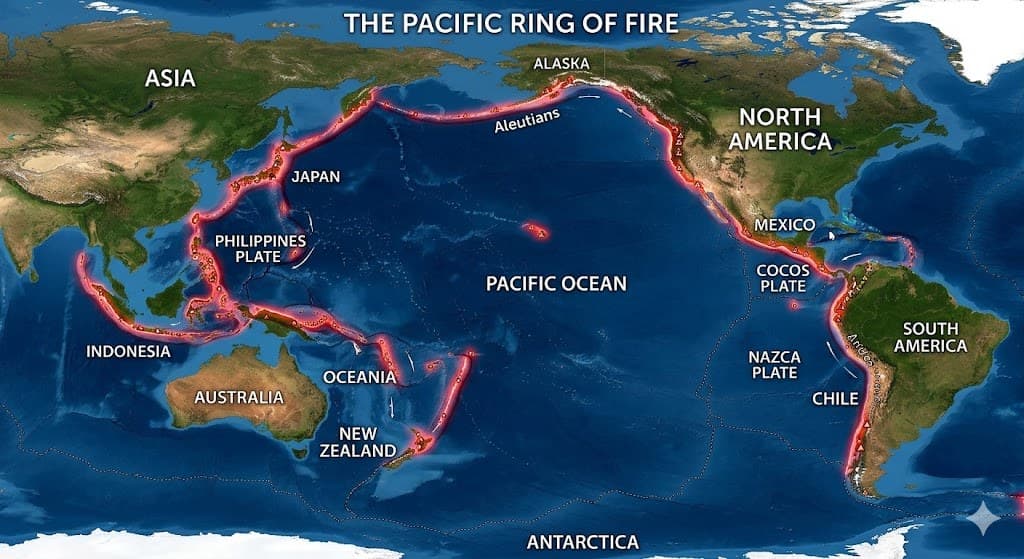
Living on the west coast of Canada has its advantages over the rest of Canada. Very little to no snow in the winter, minimal bugs in the summer and a mild climate that is pleasant almost year round. But there is one thing the rest of Canada isn't jealous about, that is the earthquake potential and the ever looming threat of “The Big One”. It is the reason we as west coasters are recommended to have days of emergency food and water on hand, and it is also the reason we sit in part of an area of the world that has access to some of the biggest and best deposits of minerals. It's best to not think about the ever looming threat that could strike as I write this or 200 hundred years from now. The Pacific Ring of Fire is home for better or for worse.
The Geological Engine
The Pacific Ring of Fire is a 40,000-kilometer arc of tectonic instability, bristling with 75% of the world's active volcanoes and the site of 90% of its earthquakes, and eventually will be responsible for the big one. While the surface is defined by destruction; underground a different story is being told. The Ring of fire contains some of the world’s most concentrated deposits of mineral wealth. The Ring of Fire has now transitioned from a geological hazard zone, to an undisputed powerhouse of global mining. It contains not just gold but base and critical minerals required to drive the global economy. It is an area of the world that every investor should have on their radar.
Without getting too into the geology, the Ring of Fire is essentially Mother Nature’s high-pressure kitchen. Its mineral abundance is the direct result of subduction zones, where oceanic plates slide beneath continental plates, creating heat and pressure.
As these plates descend, they carry water and sediments into the hot mantle. This process triggers the creation of magma that rises through the crust. Along the way, this magma interacts with surrounding rocks, leaching out metals and concentrating them into rich deposits. This is the birthplace ofporphyry deposits (the world’s primary source of copper and molybdenum) and epithermal veins (where high-grade gold and silver are found).
Current Major Production Areas
The Ring of Fire is not just a future mining prospect. It is a proven source, with proven mines. In 2026, four regions stand out as the pillars of this mineral empire:
Chile and Peru
The Andes mountains remain the global epicenter for copper. With the world shifting toward electrification, Chile and Peru have solidified their roles. In 2025, new processing technologies allowed for the extraction of copper from lower-grade ores, ensuring that these "old" mines remain productive for decades to come.
Indonesia
Indonesia has leveraged its position on the Ring of Fire to become the world’s leading nickel producer. Its volcanic soils host massive nickel laterite deposits, which are now being refined into "battery-grade" nickel for the booming electric vehicle (EV) market.
Papua New Guinea and the Philippines
Papua New Guinea remains a frontier for high-grade gold. Projects like the Feni Island and Lihir mines prove that the volcanic islands of the Pacific are essentially "gold factories," with mineralized zones that are often easier to access due to their proximity to the coast.
West Coast of North America
The west coast of North America is famous for its Gold Rushes in the past and stable mining present. This area holds a wealth of minerals from Alaska to Mexico, and is still underexplored. An example of one such underexplored area is the “Golden Triangle” in North Western British Columbia, rich in gold, silver and copper deposits.
Future Opportunities: The Shift to Critical Minerals
While gold and copper have long been the focus with mining, the Ring of Fire could be renamed the "Future Ring" as critical minerals continue to prove their importance in today's world. As we move deeper into 2026, focus on precious metals is being shared with the elements that power smartphones, AI data centers, and renewable energy grids.
Rare Earth Elements (REEs)
Rare Earth Elements are a group of metals that are essential for many modern applications, such as high-strength magnets used in wind turbines, electric vehicle motors, and military technologies. Rare Earth production and export have mainly come out of China and many western nations realise the risk of having all production from one country, let alone a major antagonist to western power.
Lithium and Cobalt
While the "Lithium Triangle" in South America is well-known, new exploration in the volcanic regions of Mexico and the Western United States (part of the Ring's eastern edge) is uncovering lithium-rich clays and brines that could challenge the current market dominance. The demand for lithium is projected to grow by 400% by 2030, making every volcanic basin in the Pacific Ring of Fire a potential "white gold" mine.
Challenges: “Green Mining” Problems
Mining the Ring of Fire is not without its hurdles. The very geological activity that creates the minerals also makes extraction difficult. As with most mining there are environmental impacts such as mining in volcanic archipelagos where activities often threaten fragile marine ecosystems or mining in the untouched forests of British Columbia. Another problem is that many of the Pacific Ring of Fire’s richest deposits are in developing nations where political shifts can impact long-term investments. In other areas such as British Columbia, the success of future projects depends on shared governance and respect for Indigenous land rights. Although these are great hurdles to development, in an increasingly uncertain world, people are becoming more supportive of critical projects that outweigh the risks.
Looking Forward
The Pacific Ring of Fire is no longer just a destination for geologists and disaster movies. It is the engine room of the modern economy. From the copper wires in our homes to the lithium in our pockets and the gold in our technology, the Pacific Ring of Fire provides and will continue to provide the raw materials that make modern life possible.
As we look toward the remainder of the 2020s, the opportunities for future mining are vast. By combining AI-driven exploration with sustainable extraction technologies, the Pacific Ring of Fire will likely remain the world's most important resource for centuries to come. This dangerous arc of unstable geology has become one of the planet's most valuable assets.
Disclaimer: This newsletter is for informational purposes only and does not constitute financial advice. Investing in junior mining companies involves significant risk.