Intercepts extracted and reviewed by Strikepoint from the issuer’s filings. True widths may differ from downhole widths; see the full release for drill orientation.
San Lorenzo Reports Final Assay Results from Hole SAL 10-25 with Drilling Ending in Porphyry Style Mineralization at the Arco de Oro Target
(TheNewswire)
CALGARY / TheNewswire /
June 4, 2026 / San Lorenzo Gold Corp.
("San Lorenzo" or the "Corporation") (TSXV: SLG) is pleased to provide
the remaining assay results from Hole SAL 10-25 on the “San Juan”
northwest extension of the Arco de Oro target. Full assay results
from Hole SAL 10–25 - that already included 102.3 metres of 1.33 g/t
gold – now include multiple additional deeper intercepts throughout
the 574.0 metre drill hole including 52.6 meters of 1.67 g/t gold,
48.0 metres of 0.91 g/t gold and ending in mineralization of 65.0
metres of 0.81 g/t gold. Results are presented below.
Hole SAL 10-25 (and Hole SAL 09-25) were 3.9 km step-outs from San
Lorenzo’s previous “core-zone” drilling at Arco de Oro. The
holes were designed to test the significant IP anomaly evident on IP
line D8 – part of additional IP data acquired during the summer of
2025. Importantly, both holes bottomed in porphyry style alteration,
with the mineralization at the bottom of holes SAL 10-25 and SAL 09-25
establishing a footprint exceeding 400 metres in width.
Terence Walker, San Lorenzo’s VP of Exploration, commented: “It is
gratifying – and exciting - that the mineralization that started at
approximately 84 metres continued right to the bottom of hole 10 which
was drilled to 574 metres. The porphyry style mineralization, with
grade, that was observed to the bottom of the hole reinforces my
belief that we are in a significant system at Arco de Oro. The
system appears much larger than suggested by our early efforts at Arco
– efforts that were focused on the shallower upper portion of the
epithermal system that extends to surface. With these holes, it
appears that we have penetrated the upper gold-rich section of a
mineralized porphyry copper-gold system. Immediate follow-up drilling
is required to delineate the intrusive complex that hosts the system
discovered in these holes”.
Mr. Walker continued: “Visual indications from the SAL 10-25 core
indicate that potassic alteration continues to strengthen and dominate
towards the bottom of the hole containing significant
multi-directional pyrite-chalcopyrite rich veins within essentially
dioritic intrusives and dykes indicating multi-episodic mineralization
events in a gold-rich porphyry copper-gold setting”.
Al Kroontje, San Lorenzo’s CEO commented: “It shouldn’t be
forgotten that IP line D8 hosts additional chargeability anomalies
that must also be drilled. If they prove out, the system has the
potential to host significant width in addition to strike that may
exceed 6 km in length. I am pleased that with the additional capital
available to us at San Lorenzo, we will expand our exploration efforts
to include testing numerous IP anomalies that we’ve known about for
many years – anomalies identified in various IP programs that San
Lorenzo undertook between 2012 and 2018”.
TheNewsWire
News by QuoteMedia - http://www.quotemedia.com
Copyright (c) 2026 QuoteMedia, Inc.
San Lorenzo completes drilling at Arco de Oro; hits porphyry mineralization | Strikepoint News
Table 1: SAL 10-25 Assay Results
Hole
Sector
Intercept
From
To
Width(m)
Au g/t
Ag g/t
Cu %
SAL
10 - 25
Arco
De
Oro
A
84.3
112.0
27.7
0.78
0.3
0.04
B
132.0
145.8
13.8
1.39
0.3
0.10
C
152.7
255.0
102.3
1.33
0.3
0.09
including
152.7
166.0
13.3
2.21
0.3
0.12
including
184.0
217.7
33.7
1.48
0.3
0.11
D
265.0
295.0
30.0
1.24
0.4
0.09
E
310.4
363.0
52.6
1.67
0.3
0.13
including
314.0
330.0
16.0
2.29
0.3
0.15
F
373.0
383.0
10.0
0.74
0.7
0.07
G
397.0
445.0
48.0
0.91
0.8
0.08
H
457.0
473.0
16.0
0.71
1.1
0.07
I
483.0
503.0
20.0
0.51
1.6
0.05
J
509.0
574.0
65.0
0.81
2.0
0.07
including
541.8
556.0
14.2
1.76
7.3
0.16
Mineralization remains open at depth
Note 1: results for hole SAL
10-25, from surface to a depth of 348 metres, were previously reported
by San Lorenzo on May 8, 2026. The results contained in this release
that are below 348 metres in depth are newly received.
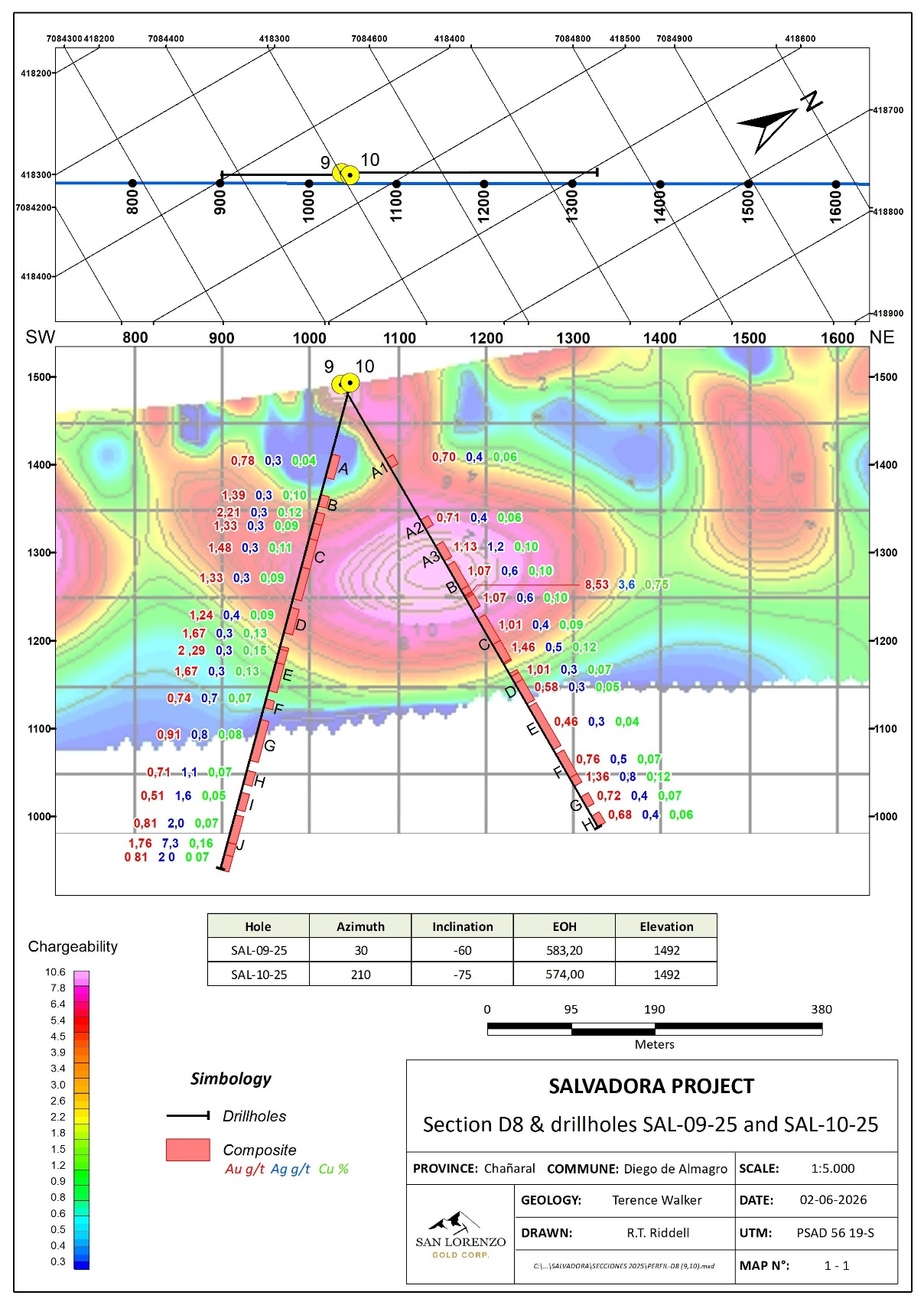
Figure 1: Section across a portion of IP line D8
indicating the location of Holes SAL 10-25 and SAL 09-25 depicting the
mineralized intercepts obtained.
Note 2: SAL 10-25 terminated in mineralization
at 574 m (65 m at 0.81g/t Au, 2.0 g/t Ag & 0.07% Cu).
Click Image To View Full Size
Table 2: Individual assay results of intercept 310.4 m
- 363 m showing grade continuity typical of porphyry style
mineralization.
Hole
From
To
Width(m)
Au g/t
Ag g/t
Cu ppm
SAL-10-25
310.42
312.00
1.58
1.53
0.3
1159
312.00
314.00
2.00
1.46
0.2
1109
314.00
316.00
2.00
1.86
0.4
1259
316.00
318.00
2.00
2.99
0.2
1890
318.00
320.00
2.00
3.23
0.3
1920
320.00
322.00
2.00
3.79
0.6
2100
322.00
324.00
2.00
1.38
0.2
1045
324.00
326.00
2.00
1.65
0.4
1248
326.00
328.00
2.00
1.66
0.3
1252
328.00
330.00
2.00
1.74
0.2
1319
330.00
332.00
2.00
1.23
0.2
935
332.00
334.00
2.00
1.47
0.3
1110
334.00
336.00
2.00
1.71
0.2
1295
336.00
338.00
2.00
1.33
0.2
1009
338.00
340.00
2.00
1.59
0.4
1208
340.00
342.00
2.00
2.13
0.3
1525
342.00
344.00
2.00
1.99
0.2
1510
344.00
346.00
2.00
2.68
0.5
2029
346.00
348.00
2.00
2.71
0.6
2022
348.00
350.00
2.00
1.28
0.4
1164
350.00
352.00
2.00
1.16
0.4
1052
352.00
354.55
2.55
1.06
0.2
965
354.55
357.11
2.56
0.824
0.7
749
357.11
359.00
1.89
0.913
0.3
830
359.00
361.00
2.00
0.205
0.3
184
361.00
363.00
2.00
0.172
0.4
156
Note 3: Results above 348 metres
in this intercept were previously reported by San Lorenzo May 8, 2026.
Additional Assays
San Lorenzo has not yet received assay results from the
remaining six holes already drilled at the Arco de Oro target. While
assay turn-around times remain frustrating, San Lorenzo is hopeful
that, with the onset of winter in the southern hemisphere, some of the
“large scale drilling programs in the high Andes” will wind down
which may help improve assay turn-around times. San Lorenzo remains
committed to providing stakeholders with regular updates as assay
results become available.
Drilling
San Lorenzo has submitted the permitting material for
the upcoming Phase 7 drilling program at Salvadora. Pad construction
followed by rig mobilization is expected to begin imminently.
Qualified Person
The scientific and technical information contained in
this news release has been reviewed and approved by Terence Walker,
M.Sc., P. Geo., the VP of Exploration of San Lorenzo who is a
"qualified person" within the meaning of National Instrument
43-101.
Testing Procedures
Samples consisting of 50% of the HQ core are delivered
to the ALS Laboratories in Copiapó by San Lorenzo staff for
preparation which consists of drying and crushing to a 2 mm mesh and
then pulverized. The sample material is then delivered to ALS’s
facilities in Lima, Peru for gold analysis using the fire assay
method. Samples were also analyzed by aqua-regia digestion to
analyze for other elements including Ag and Cu. San Lorenzo notes
that the correlation between sample intervals
and true widths are unknown as the systems are still being
modeled.
Drill Hole and Assay Data
Drill data, including individual assay results from
each of the holes presented in this news release, will be made
available on San Lorenzo’s website: www.sanlorenzogold.ca under the
Salvadora sub-heading “Drill Hole and Assay Data”.
About San Lorenzo
San Lorenzo is focused on advancing its flagship Salvadora property
located in Chile’s mega-porphyry belt. Drilling results at
Salvadora - from 4 different targets so far - have convinced
management that several gold and copper enriched epithermal and/or
porphyry style systems may be contained within the Salvadora property.
Neither the TSX Venture Exchange nor its Regulation
Services Provider (as that term is defined in the policies of the TSX
Venture Exchange) accepts responsibility for the adequacy or accuracy
of this news release.
Cautionary Note Regarding Forward-Looking
Information
This news release may contain forward-looking
information that involves substantial known and unknown risks and
uncertainties, most of which are beyond the control of San
Lorenzo. All statements
included herein other than statements of historical fact are forward-looking informationSuch forward-looking information involves various risks and
uncertainties. There can be no assurance that such information will
prove to be accurate, and actual results and future events could
differ materially from those anticipated in such information. Any
forward-looking statements are made as of the date of this release
and, other than as required by applicable securities laws, San Lorenzo
does not assume any obligation to update or revise them to reflect new
events or circumstances.
Copyright (c) 2026 TheNewswire - All rights reserved.