



Kalo Gold confirms epithermal system over 1.8 km at Wainikoro, Fiji
VANCOUVER, BC / ACCESS Newswire / June 30, 2026 / Kalo Gold Corp. (TSX-V:KALO)(OTCID:KLGDF)(FSE:9M51) ("Kalo", "Kalo Gold" or the "Company") is pleased to report geochemical and mineralogical results from two reconnaissance drill holes VA26-DH18 and VA26-DH19 completed at Wainikoro within its 100%-owned Vatu Aurum Project.
The two wide-spaced (1,027 m) reconnaissance drill holes were designed to test the potential for gold mineralisation associated with regional faulting, hydrothermal brecciation, elevated arsenic and epithermal pathfinder geochemistry and coincident geophysical anomalies identified at Wainikoro. Results from both holes confirm the presence of anomalous gold associated with fault-controlled quartz veins and continue to support the Company's interpretation that Wainikoro represents a structurally controlled epithermal gold system. These reconnaissance holes were drilled as geological vectoring holes, intended to advance the geological model, improve the Company's understanding of the scale of the system and guide future drill targeting.
Highlights
VA26-DH19 intersected multiple low-grade gold-bearing quartz veins within a broad hydrothermal system.
Gold-bearing veins found at surface are associated with elevated arsenic and antimony, characteristic of high-level epithermal systems.
QEMSCAN (Quantitative Evaluation of Minerals by Scanning Electron Microscopy) analysis identified arsenopyrite replaced by pyrite pseudomorphs, interpreted as an early mineralizing phase.
VA26-DH18 returned anomalous gold values associated with elevated arsenic within hydrothermal breccias and fault zones.
Surface sampling from quartz veins and hydrothermal breccias surrounding VA26-DH18 returned detectORE™ values up to 1,920 dU (~1.92 g/t Au estimated).
Results demonstrate that gold-bearing hydrothermal activity extends across the 1.8-kilometre-long Wainikoro magnetic-low target, one of several identified within the broader district.
Ground geophysical survey (CSAMT, IP and gravity) will be completed by Fender Geophysics Pty Ltd at Wainikoro, scheduled to commence in mid-July 2026 to refine drill targeting.
CEO Commentary
Terry L. Tucker, P.Geo., President and CEO of Kalo Gold, commented: "These results strengthen our confidence that Wainikoro is a structurally controlled, multi-stage hydrothermal gold system developed along the Nubu Graben corridor. The widespread alteration, multi-stage quartz veining, strong arsenic and mercury pathfinder signature, and arsenopyrite-related mineralization all support the presence of a fertile epithermal system. Importantly, mineralization intersected in VA26-DH18 demonstrates that gold-bearing hydrothermal activity extends beyond the main 1.8-kilometre magnetic-low target, highlighting the potential for multiple mineralized centres across the broader Wainikoro area. With gold-bearing quartz veins now confirmed in drilling, the integration of drilling, airborne magnetics and the planned CSAMT, IP and gravity surveys will allow us to prioritize and target future drilling with significantly greater precision as we continue to evaluate the scale and architecture of the Wainikoro epithermal system."
VA26-DH19 - Kope Road North
Drill hole VA26-DH19 (270.6 m) was designed to test the eastern extent of a 1.8-kilometre-long coincident magnetic low and arsenic-in-soil anomaly previously reported by the Company. The hole was oriented to intersect the principal bounding fault of the Nubu Graben, a major structural corridor interpreted to have focused hydrothermal fluid flow.
The drill hole intersected extensive hydrothermally altered andesitic breccias from 75.6 m to 188.5 m before crossing the interpreted Nubu Graben-bounding fault zone at approximately 268 metres depth.
This altered interval contains dispersed quartz veins and distinctive lath-shaped sulphide crystals. These quartz veins are consistently associated with elevated arsenic and antimony values, a geochemical association commonly observed in the upper levels of epithermal gold systems.
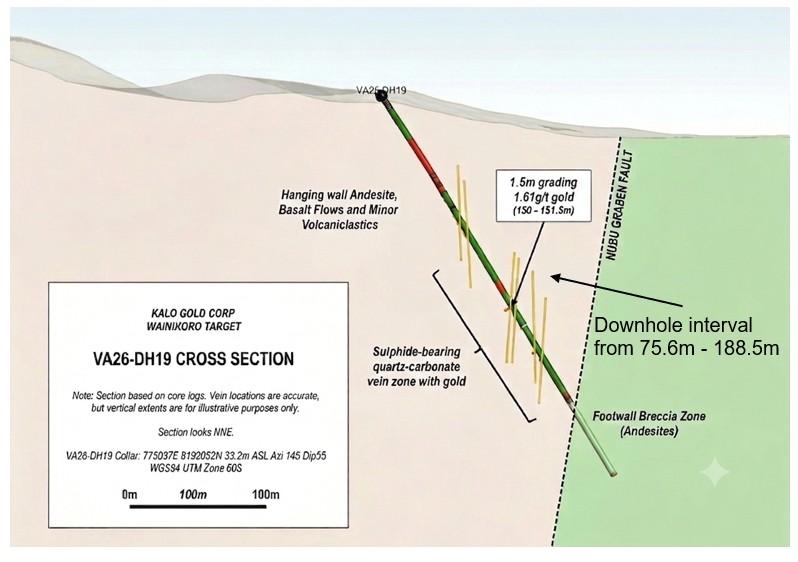
Figure 1. VA26-DH19 cross-section (Wainikoro) showing the drill hole through hanging-wall andesite, basalt flows and minor volcaniclastics, a sulphide-bearing quartz-carbonate vein zone returning 1.5 m at 1.61 g/t Au (150.0-151.5 m), the Nubu Graben Fault and the footwall breccia zone in andesites.
Fire assays (and dU values) from individual intervals returned:
From (m) | To (m) | Interval (m) | Gold (g/t Au) | Gold (dU Au)* |
|---|---|---|---|---|
75.60 | 77.00 | 1.40 | 0.23 | <> |
85.00 | 86.50 | 1.50 | 0.23 | <> |
89.30 | 91.00 | 1.70 | 0.23 | <> |
97.00 | 98.50 | 1.50 | 0.32 | 170 |
98.50 | 100.00 | 1.50 | 0.26 | 79 |
100.00 | 101.50 | 1.50 | 0.25 | 39 |
130.50 | 132.00 | 1.50 | 0.37 | 70 |
150.00 | 151.50 | 1.50 | 1.61 | 85 |
154.50 | 156.00 | 1.50 | 0.31 | <> |
157.50 | 159.00 | 1.50 | 0.41 | <> |
160.50 | 162.00 | 1.50 | 0.23 | <> |
164.24 | 165.50 | 1.26 | 0.27 | <> |
181.00 | 182.50 | 1.50 | 1.08 | 55 |
187.00 | 188.50 | 1.50 | 0.37 | <> |
*Where gold is hosted within sulphide minerals, the on-site crushing and leaching process of the detectORE™ system does not fully liberate all the gold prior to analysis, resulting in dU values that underestimate fire assay grades in these intervals.
QEMSCAN analysis of selected sulphide-bearing vein samples, completed at Intertek (Kamloops, Canada), indicates that the lath-shaped sulphide crystals were likely originally arsenopyrite and were subsequently replaced by pyrite, preserving their original crystal morphology as pseudomorphs. The presence of arsenopyrite is considered significant, as it may represent an early mineralizing phase associated with gold deposition within the hydrothermal system.
VA26-DH18 - Kope Road South
Drill hole VA26-DH18 (245.7 m), drilled at Kope Road South prior to the airborne magnetic survey, returned anomalous gold mineralization associated with elevated arsenic in hydrothermal breccias and fault zones. Associated trench and surface samples returned detectORE™ values up to 1,920 dU (~1.92 g/t Au estimated; see Technical Notes on detectORE™ Gold Screening Results). The hole demonstrates that gold-bearing hydrothermal activity extends beyond the main Wainikoro magnetic-low target.
Fire assays from brecciated and faulted intervals returned:
From (m) | To (m) | Interval (m) | Gold (g/t Au) | Gold (dU Au)* |
|---|---|---|---|---|
15.50 | 17.22 | 1.72 | 0.32 | <> |
24.00 | 26.00 | 2.00 | 0.31 | 44 |
*Where gold is hosted within sulphide minerals, the on-site crushing and leaching process of the detectORE™ system may not fully liberate all the gold prior to analysis, resulting in dU values that underestimate fire assay grades in these intervals.
Geological Interpretation
Results from both drill holes support the interpretation that Wainikoro hosts a structurally controlled hydrothermal system centred on the Nubu Graben fault corridor. Surface mapping and detectORE™ sampling at Wainikoro indicate that gold-bearing veins occur on multiple orientations - E-W, NE-SW and NW-SE - with the strongest responses where these structural trends intersect.
The association of gold with elevated arsenic and antimony, together with the widespread occurrence of hydrothermal brecciation, silicification, faulting, and arsenopyrite-bearing veins, suggests the Company may be exploring the upper levels of an epithermal gold system.
Detailed logging and petrographic review of VA26-DH19 further support this interpretation. The hole intersected a significant volume of intense clay (illite-dominant, with subordinate chlorite) and silica alteration, together with at least three generations of quartz veining - early quartz-hematite veins, cut by quartz-carbonate-pyrite veins, and later quartz ± carbonate veins - consistent with long-lived, multi-pulse hydrothermal activity. The hole also intersected coherent andesite, a competent host rock favourable for the development of continuous quartz veins.
Importantly, mineralization identified in VA26-DH18 demonstrates that gold-bearing hydrothermal activity extends beyond the currently defined magnetic-low target, highlighting the potential for multiple mineralized centres across the broader Wainikoro area. Consistent with the Company's measured, data-led approach, the next phase of drilling will follow integration of the recently completed airborne magnetic and radiometric survey and the planned ground geophysics into the project-wide exploration model.
The Company has engaged with Fender Geophysics Pty Ltd to complete a CSAMT, IP and Gravity ground geophysical survey at Wainikoro with work scheduled to commence mid-July, subject to any import requirements and crew scheduling requirements.
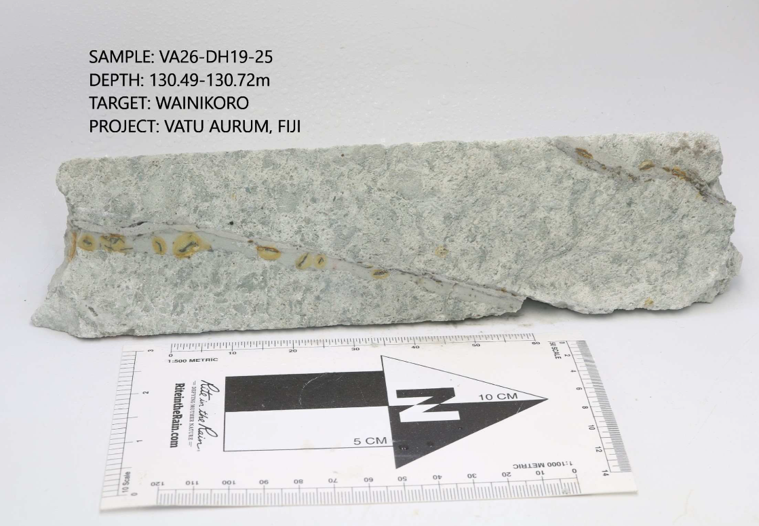
Figure 2. VA26-DH19 - highly altered core with veins and lath-shaped pyrite pseudomorphs.
Technical Notes on detectORE™ Gold Screening Results
This news release references gold (Au) values reported in detectORE™ Units ("dU"), generated using the detectORE™ field-based gold analysis system developed by Portable PPB Pty Ltd. dU values represent a semi-quantitative, ppb-equivalent measure of leachable gold response and are used for exploration screening purposes only. They are not a direct measure of total gold content and are not equivalent to certified Fire Assay results. Accordingly, dU results are not used to estimate Mineral Resources or Mineral Reserves.
Internal validation by the Company in 2025 on 824 Vatu Aurum samples showed a strong correlation between dU and certified Fire Assay (Pearson R = 0.98 for drill core; R = 0.96 for trench samples). Soil dU has not been directly validated against Fire Assay, and the relationship is variable and influenced by lithology, mineralogy and sample preparation. Where gold is hosted within sulphide minerals, the on-site crushing and leaching process of the detectORE™ system does not fully liberate all gold prior to analysis, resulting in dU values that underestimate fire assay grades in these intervals. Any approximate equivalence (e.g. ~1,000 dU ≈ ~1 g/t Au) is for contextual reference only and must not be relied upon for grade estimation. See the Company's news release dated 24 February 2026 for full details.
Qualified Person
The technical information in this news release was prepared, reviewed, and approved by Andrew Randell, P.Geo., CEO and Principal Geoscientist of SGDS-Hive, Technical Director of the Vatu Aurum Project, and a Qualified Person as defined by NI 43-101. Mr. Randell is independent of the Company and has verified the data disclosed, having conducted multiple site visits (2023-2026) and direct supervision of the exploration program.
Quality Assurance / Quality Control
Soil, traverse and trench samples were collected under qualified geological supervision following industry-standard protocols, with on-site XRF analysis using calibrated portable analyzers. detectORE™ screening data is QA/QC-managed through Portable PPB's pLIMS system (calibration verification, reference materials, blanks and duplicates). Gold assays for drill core from VA26-DH18 and VA26-DH19 were determined by ALS Limited (Australia) using method Au-AA25 (30 g Fire Assay, AAS Finish); ALS is accredited by NATA to ISO/IEC 17025 and is independent of the Company and the Qualified Person.
About Kalo Gold Corp.
Kalo Gold Corp. is a gold exploration company advancing the 100%-owned Vatu Aurum Project (Special Prospecting Licences 1511 and 1464), a 367 km² land package on Vanua Levu, Fiji, located in a preserved volcanic back-arc setting. The Company's work is focused on a northeast-trending corridor of low-sulphidation epithermal gold targets. Exploration across the corridor - including at the flagship Aurum Prime area and Wainikoro - has defined multiple structurally controlled gold targets supported by drilling, trenching, soil geochemistry, structural mapping and airborne geophysics. The Company is systematically advancing high-confidence targets toward potential discovery.
Kalo Gold Corp. is headquartered in Vancouver, British Columbia, and is listed on the TSX Venture Exchange (KALO), the OTCID Market (KLGDF), and the Frankfurt Stock Exchange (9M51).
On behalf of the Board of Directors of Kalo Gold Corp.
Terry L. Tucker, P.Geo.
President and Chief Executive Officer
Kevin Ma, CPA, CA
Executive Vice President, Capital Markets and Director
For further information: info@kalogoldcorp.com | www.kalogoldcorp.com
Neither the TSX Venture Exchange nor its Regulation Services Provider (as that term is defined in the policies of the Exchange) accepts responsibility for the adequacy or accuracy of this press release.
Cautionary Statement Regarding Forward-Looking Information
This news release contains "forward-looking statements" and "forward-looking information" within the meaning of applicable Canadian securities laws. Forward-looking statements can often be identified by the use of words such as "will", "may", "should", "could", "would", "anticipate", "believe", "estimate", "expect", "intend", "plan", "potential", "continue", "target", "scheduled", and similar expressions, or statements that certain events or conditions "will", "may", or "could" occur.
Forward-looking statements in this news release include, but are not limited to: (i) the interpretation that drill holes VA26-DH18 and VA26-DH19 intersected the upper levels of a structurally controlled, low-sulphidation epithermal gold system at Wainikoro; (ii) the interpretation that gold-bearing hydrothermal activity extends beyond the main Wainikoro magnetic-low target, and the potential for multiple mineralized centres across the broader Wainikoro area; (iii) the interpretation of QEMSCAN mineralogical results (lath-shaped crystals interpreted as arsenopyrite subsequently replaced by pyrite pseudomorphs) as indicative of an early mineralizing phase and a potentially fertile system; (iv) the interpretation that elevated arsenic and antimony, multi-stage quartz veining, hydrothermal brecciation and silicification reflect a fertile, structurally controlled hydrothermal system with potential for stronger mineralization at depth; (v) the timing, scope and results of planned follow-up drilling and sampling along the Nubu Graben structural corridor and on structurally controlled targets identified outside the main magnetic-low anomaly; and (vi) the Company's ability to secure financing, permits and regulatory approvals required to advance exploration on the Vatu Aurum Project.
Forward-looking statements are based on a number of assumptions that the Company considers reasonable but which may prove to be inaccurate, including: that the Company will be able to fund and execute the planned exploration programs; that permits, tenure, and licences will remain in good standing; that there will be no adverse change in the political, regulatory, or operational environment in Fiji, including potential fuel shortages; and that commodity prices and capital markets conditions will support continued exploration.
Forward-looking statements are subject to known and unknown risks and uncertainties that may cause actual results, performance, or achievements to differ materially from those expressed or implied, including: exploration and drilling risk; the risk that detectORE™ dU screening results may not be confirmed by certified Fire Assay (detectORE™ dU values are semi-quantitative screening estimates and are not equivalent to quantitative gold grades; soil dU results have not been directly validated against Fire Assay); the risk that geological, geochemical, geophysical, and structural interpretations may change with additional data; permit, tenure, and title risk; risks of operating in Fiji, including fuel supply, logistics, and currency risk; dependence on key personnel; environmental, health, and safety risk; financing and dilution risk; and commodity price volatility. Readers are cautioned not to place undue reliance on forward-looking statements.
The Company does not undertake any obligation to update or revise any forward-looking statements, whether because of new information, future events, or otherwise, except as required by applicable securities laws. Readers are directed to the Company's continuous disclosure filings available on SEDAR+ at www.sedarplus.ca, including its most recent Management's Discussion and Analysis, for a more complete discussion of the risks affecting the Company and its business.
Drill Collar Locations
Hole ID | Easting | Northing | Azimuth (°) | Dip (°) | Total Depth (m) |
VA26-DH18 | 774363 | 8191271 | 315 | 65 | 245.7 |
VA26-DH19 | 775037 | 8192052 | 145 | 55 | 270.6 |
Collar coordinates are presented in WGS84 UTM Zone 60S.
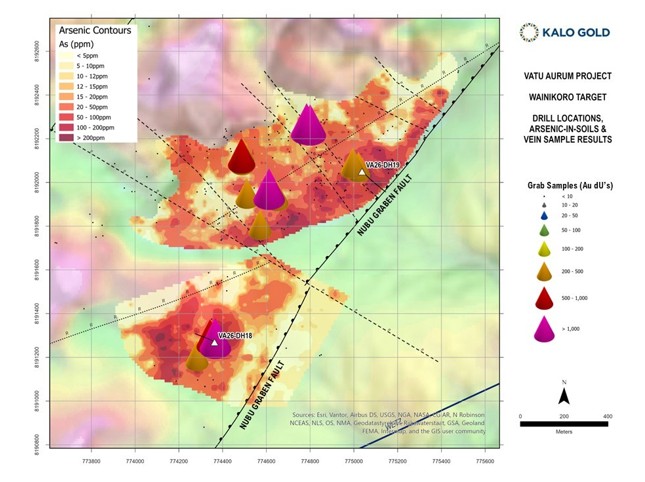
Figure 3. Wainikoro - VA26-DH18 and VA26-DH19 drill collar locations on arsenic-in-soil contours (ppm), with surface grab-sample detectORE™ gold results (dU) and the interpreted Nubu Graben Fault
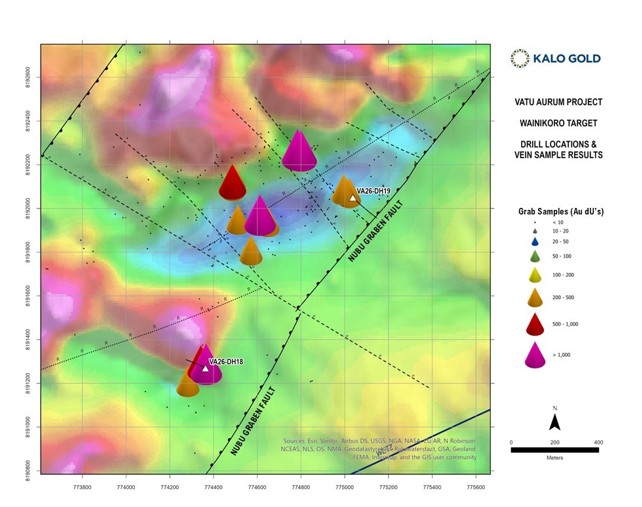
Figure 4. Wainikoro - VA26-DH18 and VA26-DH19 drill collar locations on airborne magnetics, with surface grab-sample detectORE™ gold results (dU) and the interpreted Nubu Graben Fault.
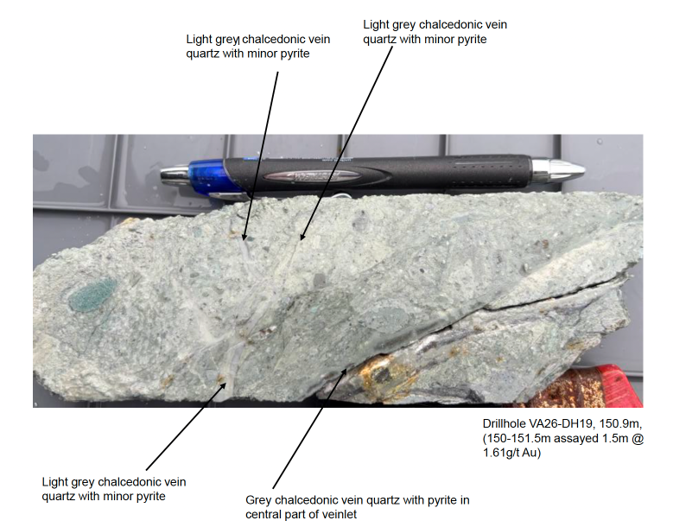
Figure 5. VA26-DH19, 150.9 m - light-grey chalcedonic vein quartz with minor pyrite (interval 150.0-151.5 m, 1.61 g/t Au over 1.5 m).
SOURCE: Kalo Gold Corp.
View the original press release on ACCESS Newswire
bayaw
News by QuoteMedia - http://www.quotemedia.com
Copyright (c) 2026 QuoteMedia, Inc.