Alaska Energy Metals Announces Drilling Program for the Mcbride Prospect, Angliers-Belleterre Project, Quebec, Canada
HIGHLIGHTS:
Planned core drilling program (8 holes - 2,125 meters) to test the McBride prospect where copper-nickel-iron sulfide showings at surface are underlain by coincident electromagnetic - magnetic geophysical and geochemical anomalies.
Authorization for impact-causing exploration work (ATI) permit has been received.
Drill crew is expected to mobilize in mid-August 2026.
VANCOUVER, BC / ACCESS Newswire / August 10, 2026 / Alaska Energy Metals Corporation (TSX-V:AEMC)(OTCQB:AKEMF) ("Alaska Energy Metals" or the "Company") is pleased to announce that it has completed planning for a core drilling program to test geological - geophysical - geochemical targets at the McBride prospect, that forms part of its Angliers Project in Quebec, Canada. The Company's geochemical - geophysical results and historical drill results for the McBride Prospect were released in a press release dated January 21, 2025. The core drilling program includes plans for eight holes for a total of 2,125 meters. Authorization for impact-causing exploration work (ATI) permit has been received from the Ministry of Natural Resources and Forestry. The drilling is anticipated to start in mid-August.
In 2024, AEMC completed a 200x100m grid surface soil sampling and prospecting program over the McBride Prospect. Multiple anomalous zones of copper, zinc, nickel, silver, and gold have been revealed that correspond to a series of Versatile Time Domain Electromagnetic ("VTEM") anomalies that align within an east-west trending zone. Several significant anomalous rock samples containing magmatic sulfides collected in 2024 include:
Sample 135040: Massive sulfides (pyrrhotite, pyrite and minor chalcopyrite) - 302 ppm copper, 153 ppm zinc, 1.02 ppm silver and 0.5 ppb gold
Sample 135042: Silicified with sulfides (pyrite and chalcopyrite in blebs and stringers) - 1287 ppm copper, 2433 ppm nickel, 260 ppm zinc, 522 ppm cobalt, 0.63 ppm silver, and 2.0 ppb gold
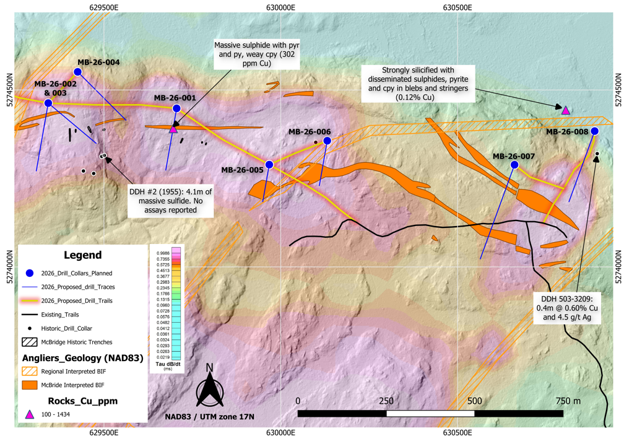
VTEM surveys conducted by the Company in 2024 identified strong, low-resistivity and conductive zones immediately beneath sulfide and banded iron formation occurrences. Interpreted banded iron formations show a sharp, narrow increase in magnetic response in the VTEM survey. In locations of surficial massive sulfide samples, a broad magnetic response is encountered prior to the sharp, narrow increase in magnetic response from the banded iron formation. It is hypothesized that the conductive zone and broad magnetic response may be caused by copper-nickel sulfides adjacent to the banded iron formations in an underexplored VMS stratigraphic setting. Multiple drill holes are planned to test for massive sulfide mineralization along these anomalies, shown in Figure 2.
View the original on ACCESS Newswire
bayaw
News by QuoteMedia - http://www.quotemedia.com
Copyright (c) 2026 QuoteMedia, Inc.
Figure 1. 2026 McBride Prospect Drill Program. Note: Historic drill collar locations have not been verified in the field and data from these holes and trenches is reliant on Quebec Assessment Report GM20938 and GM22119.
Sampling and Analytical Procedures
The rock sample results mentioned in this press release were collected and analyzed according to the procedures summarized below. Rock sample locations were recorded with Android rugged smart phones running Q-Field data collection software in map datum UTM WGS84 Zone 17N. Each sample was photographed and placed in a plastic bag with a uniquely numbered tag. The bag was then sealed with a plastic tie-wrap. Blanks and standards were inserted at regular intervals for QAQC purposes. Up to ten samples were placed in rice bags, sealed with numbered tamper proof tie wraps and then delivered in person to Manitoulin Transport in New Liskeard, Ontario from where they were transported to SGS Laboratory ("SGS") in Lakefield, Ontario.
At SGS, the rock samples were dried at 105°C, crushed to 75% passing 2 mm and then riffle split to a 250g sub-sample that was pulverized to pulps 85% passing 75 microns (SGS Code PRP89). The rock pulps were analyzed for 49 elements by 25-gram 2-acid Aqua Regia digestion ICP-MS analysis (SGS Code GE_ARM3V25). SGS is independent of the Company and accredited under ISO/IEC 17025 registration.
BAMBINO OPTION
Previously, AEMC executed an option to purchase agreement with local prospectors. The Bambino claim block formed a portion of the Angliers-Belleterre project. After reviewing geochemical and geophysical survey results, the Company elected to withdraw from the agreement.
QUALIFIED PERSON
Mark Fekete, of Breakaway Exploration Management inc. ("Breakaway"), a registered Professional Geologist Quebec and a Qualified Person as defined by National Instrument 43-101, Standards of Disclosure for Mineral Projects, has reviewed and approved the technical disclosure in this news release. Breakaway has been executing exploration work on behalf of and under the supervisions of AEMC and will be conducting the planned drilling program at the McBride prospect.
Gregory Beischer, AEMC President & CEO has also reviewed and approved the technical disclosure in this press release. Mr. Beischer is a registered professional geologist (#10505) with the American Institute of Professional Geologists.
Alaska Energy Metals Corporation (AEMC) is an Alaska-based corporation with offices in Anchorage and Vancouver working to sustainably deliver the critical materials needed for U.S. national security and a bright energy future, all while generating superior returns for shareholders.
AEMC is focused on delineating and developing the large-scale, bulk tonnage, polymetallic Nikolai Project and related Eureka deposit containing nickel, copper, cobalt, chromium, iron, platinum, palladium, and gold. Located in Interior Alaska near existing transportation and power infrastructure, its flagship project, Nikolai, is well-situated to become a significant domestic source of strategic metals for North America. In January 2026, AEMC's Nikolai Project was accepted for Fast-41 Transparency Dashboard listing to streamline federal permitting for overland access and man camp placement for the next phase of Eureka deposit drilling. AEMC also holds a secondary project in western Quebec; the Angliers - Belleterre project. Today, material sourcing demands excellence in environmental performance, technological innovation, carbon mitigation and the responsible management of human and financial capital. AEMC works every day to earn and maintain the respect and confidence of the public and believes that environmental, social and governance performance is measured by action and led from the top.
ON BEHALF OF THE BOARD "Gregory Beischer" Gregory Beischer, President & CEO
FOR FURTHER INFORMATION, PLEASE CONTACT:
Gregory A. Beischer, President & CEO Toll-Free: 877-217-8978 | Local: 604-609-7149
Some statements in this news release may contain forward-looking information (within the meaning of Canadian securities legislation), including, without limitation, the execution of a drilling program consisting of eight drill holes at the Company's Angliers project. These statements address future events and conditions and, as such, involve known and unknown risks, uncertainties, and other factors which may cause the actual results, performance, or achievements to be materially different from any future results, performance, or achievements expressed or implied by the statements. Forward-looking statements speak only as of the date those statements are made. Although the Company believes the expectations expressed in such forward-looking statements are based on reasonable assumptions, such statements do not guarantee future performance, and actual results may differ materially from those in the forward-looking statements. Factors that could cause the actual results to differ materially from those in forward-looking statements include but are not limited to uncertainty relating to the estimation of mineral resources, regulatory actions, market prices, and continued availability of capital and financing, and general economic, market or business conditions. Investors are cautioned that any such statements are not guarantees of future performance and actual results or developments may differ materially from those projected in the forward-looking statements. Forward-looking statements are based on the beliefs, estimates and opinions of the Company's management on the date the statements are made. Except as required by applicable law, the Company assumes no obligation to update or to publicly announce the results of any change to any forward-looking statement contained or incorporated by reference herein to reflect actual results, future events or developments, changes in assumptions, or changes in other factors affecting the forward-looking statements. If the Company updates any forward-looking statement(s), no inference should be drawn that it will make additional updates with respect to those or other forward-looking statements.
Neither the TSX Venture Exchange nor its Regulation Services Provider (as that term is defined in the policies of the TSX Venture Exchange) accepts responsibility for the adequacy or accuracy of this press release.